Module 01
Recognize
Compare an unusual episode with this person’s usual pattern, across movement, awareness, behavior, and seizure-event presentations.
Seagull Health workshop
A subtype-focused workshop for people supporting someone with dementia.
Practice noticing and describing unusual episodes in people living with Alzheimer’s, Lewy body, frontotemporal, vascular, and mixed dementia. Learn what to observe, document, and communicate—without being asked to diagnose a seizure.
$199 one-time: the complete workshop and facilitator license. Includes four interactive modules, six practice cases, learning records, a facilitator guide, printable worksheets, and editable invitation and session-report templates. Use it for paid client sessions as one named facilitator, or internal sessions at one named organization.
Four modules · Six practice cases · Five dementia types · 30 to 45 minutes
Free sample · Dementia with Lewy bodies
Three ways to write up the same forty seconds. Only one of them keeps what the observer actually knows.
Usual pattern: Ellis’s alertness varies across the day. Earlier this morning Ellis was speaking in sentences while seated.
At 10:15, while seated and talking, Ellis stops mid-sentence and does not answer two spoken questions for about 40 seconds. Ellis then speaks again. The observer did not check whether this was a full return to Ellis’s usual state.
The scenario is invented. Fluctuating alertness and episodes of reduced responsiveness are recognized features of DLB and can overlap with other explanations. See McKeith et al., 2017. This exercise does not determine a cause.
The same observation. A different context.
In Lewy body dementia, alertness fluctuates, so a pause has to be compared against that person’s own variability. In language-led frontotemporal dementia, spoken answers were already effortful, so the familiar nonverbal response is the more sensitive baseline. After vascular injury, an old deficit must not be allowed to absorb a new one. Subtype context sharpens the observation. It never settles the cause.
Module 01
Compare an unusual episode with this person’s usual pattern, across movement, awareness, behavior, and seizure-event presentations.
Module 02
Separate observations from assumptions about intent or cause. Preserve documented diagnoses while describing the new episode accurately.
Module 03
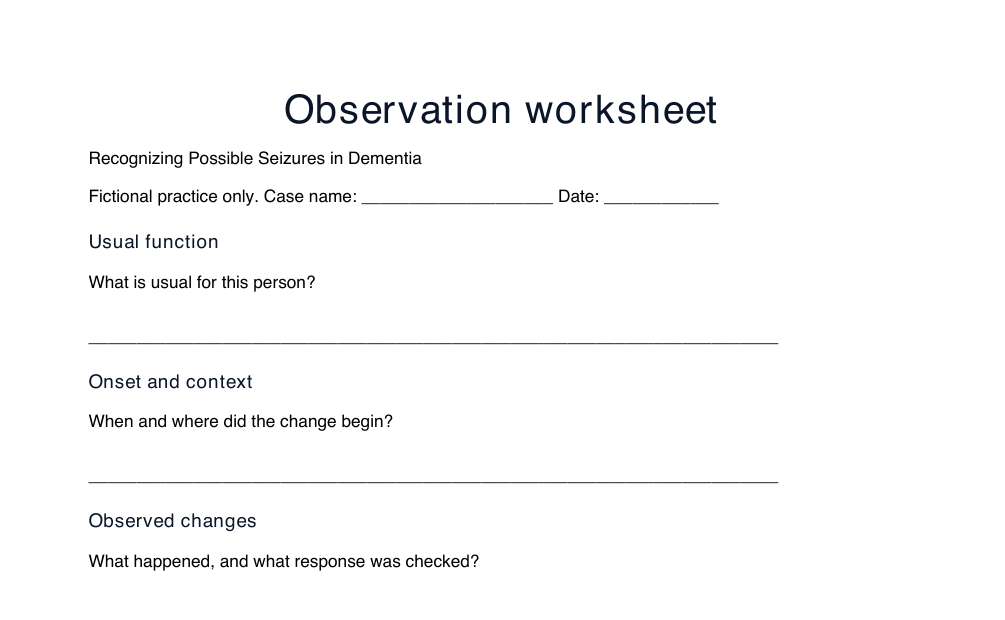
Write a six-part account another person can use: usual function, onset, observed change, duration, recovery, and what was never checked.
Module 04
Route the observation through the care and emergency pathway appropriate to the setting, including knowing when nothing should wait for paperwork at all.
Cases span Alzheimer’s, Lewy body, frontotemporal, vascular, and mixed dementia. Read the sources, scope, and review status →
Facilitator license
For educators, consultants, community groups, healthcare services, and organizations supporting people with dementia. The free sample shows how the teaching works; purchased access unlocks the complete workshop and delivery materials.
$199 one-time · USD
One named facilitator. Unlimited paid live sessions for your clients, or internal delivery at one named organization. No renewal fee.
After Seagull confirms payment, you receive your private buyer link by email within one business day. Your access page includes a separate participant link for your licensed sessions. Save your private link and receipt. Full refund on request within 14 days, no questions asked; reach us through the contact page.
Inside the purchased materials
These excerpts are taken from the finished facilitator guide and participant worksheet.
“What would we need to know about Ellis’s usual fluctuations?”
The guide provides timings, discussion prompts, teaching notes, all case answers, and preparation steps.
View a guide pageUsual function · Onset and context · Observed changes · Duration · Recovery · Unknowns
View a worksheet pageParticipants save their own learning records. The facilitator collects any agreed results and completes the session summary manually. The workshop does not identify participants or verify attendance.
This workshop is educational and evidence-informed. It does not diagnose seizures, recommend treatment, provide emergency services, or replace clinical judgment, an individual care plan, organizational policy, or emergency procedures. All people and episodes in it are invented. For an actual health concern, follow the person’s care plan and contact an appropriate healthcare professional or emergency service as the situation requires. Do not use this session to decide whether to seek help.